About WATER-Water Heat Exchangers Series KP20, KP24
WATER-Water Heat Exchangers Series KP20, KP24
|
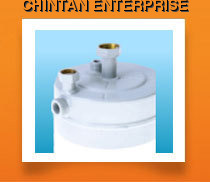
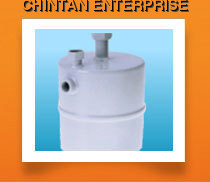
| MAIN CHARACTERISTICS : These heat exchangers are made for use in combined domestic boilers with rapid heating of domestic hot water. This water runs inside a copper coil wrapped in three concentric spirals with different diameters. The primary circuit is connected to the heating circuit and consists of a series of cylindrical baffles that force water to make multiple vertical passes in order to efficiently move against the outer surface of the copper tube. Both internal circuits are welded to threaded connections for installing the heat exchanger in the plumbing circuit. These is also a version for direct connection with a diverter valve for interchanging fluid flow when there is a request for domestic hot water. These units differ from K series because of their compact vertical dimensions that permit better exploitation of the space inside the boiler. |
MATERIALS- External shell steel
- Internal separators steel
- Relief valve Brass
- Secondary circuit coil copper tube
- Primary and secondary circuit connections: Steel
|
Key Features and ConstructionKP20 and KP24 heat exchangers stand out with their durable build and performance versatility. Their shell diameters (KP20: 200 mm; KP24: 240 mm), tube materials, and design pressure make them suitable for demanding applications. IP55 protection and manual control add reliability, while three-phase operation at 415V AC supports robust industrial setups.
Applications and VersatilityThese heat exchangers excel in water-to-water systems for HVAC, industrial heating, and cooling. Their adaptability for both floor-mounted and skid-mounted installations supports a range of operational needs in factories, commercial buildings, and technical environments across India.
Advantages of Series KP20, KP24Users benefit from high thermal efficiency, flexible installation, and compatibility with custom cable lengths and connection types. The models are engineered for easy integration, providing consistent temperature regulation and energy savings in various operational contexts.
FAQs of WATER-Water Heat Exchangers Series KP20, KP24:
Q: How do I select between the KP20 and KP24 heat exchanger models?
A: Model selection primarily depends on your required heat transfer area and space availability. KP20 offers a 200 mm shell diameter at approximately 55 kg, while KP24 provides a larger 240 mm shell and weighs around 85 kg, supporting increased capacity.
Q: What is the process of installing the KP20 or KP24 heat exchanger?
A: Installation involves securing the unit using floor or skid mounts, connecting piping via flanged or threaded connections, and wiring for three-phase power (415V AC). Ensure the system operates within the specified pressure (up to 6 bar) and temperature (max 150C) limits.
Q: Where are these heat exchangers commonly used?
A: KP20 and KP24 models are widely implemented in water-to-water solutions for HVAC, industrial heating and cooling, and similar applications within manufacturing facilities, commercial buildings, and technical plants.
Q: What are the benefits of choosing copper or stainless-steel tubes?
A: Copper tubes offer excellent thermal conductivity and corrosion resistance, ideal for efficient heat transfer. Stainless steel tubes provide added durability and are suitable for environments requiring higher resistance against aggressive fluids or conditions.
Q: When should I opt for a 2-pass versus a 4-pass configuration?
A: A 2-pass option is suitable for standard heat exchange requirements; select a 4-pass configuration for enhanced heat transfer performance or where greater temperature differentials are needed between water circuits.
Q: How does the manual control type work in these exchangers?
A: Manual control allows operators to directly manage operating parameters, such as start/stop and process adjustments, enhancing on-site reliability and responsiveness to operational changes.
Q: What advantages does the IP55 rating provide?
A: IP55 protection shields the heat exchanger from dust ingress and water jets, ensuring safe and reliable operation even in challenging industrial environments.






 Send Inquiry


 Send Inquiry
