About Electrical Shunt Gate Valves Serie VDE
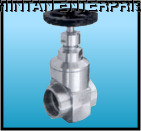
Electrical Shunt Gate Valves Serie VDE
MAIN CHARACTERISTICS : Series 1000 and 2000 three and four-way valves with butterfly rotor or circular segments can mount two types of electric servo controls. They are equipped with travel stop microswitches designed to the electrical power supply and with clutch devices that permit the valves to be manually actuated. Both motor are equipped with an auxiliary microswitch. The servo controls that available for the various valve sizes listed in the overall dimension table (table3). MANUAL CONTROL AND OPERATION : All electrical servo controls achieve on/off type adjustment (with SPDT electric control) or modulating adjustment (type P adjustment with step by step motors). Maximum angular travel is 90 (fixed standard setting of the travel stop microswitches). During manual adjustment the position of the gate is controlled by the pointer of the adaptor at graduated label on the valve body. Manual adjustment is performed as follows: For the ON/OFF version: just press the release pus-button placed above the servomotor (see Fig.3).
- For V 200 rotate the manual control knob on the servomotor or, as an alternative, the handle placed between the servomotor and the valve itself.
- For M 1000 rotate the manual control handle placed between the servomotor and the valve itself.
These are no manual control for the MODULATING version excepted by removing the servomotor from the valve and controlling the valve using its own manual knob. This konb also works as an adaptor with the sermotor.
NOTE: the servomotor must not be installed with its front facing down.
Advanced Protection and Versatile MountingWith an IP65 electric actuator and robust epoxy powder coating, Serie VDE valves stand up to harsh environments and demanding workloads. The flexibility of horizontal or vertical mounting simplifies integration into new or existing piping systems without compromising operational integrity.
Precision Operation and Reliable SealingThese shunt gate valves incorporate a resilient seated mechanism and advanced sealing with EPDM, NBR, or PTFE options. Graphite/PTFE packing and stainless steel stems (304/316) ensure accuracy and minimal leakage, making them ideal for handling water, steam, oil, air, and neutral liquids across various pressure ratings.
FAQs of Electrical Shunt Gate Valves Serie VDE:
Q: How is the Electrical Shunt Gate Valve Serie VDE installed for optimal performance?
A: The valve is designed for easy installation in either horizontal or vertical orientation. Its flanged end connection and rising stem structure ensure stability and secure mounting in industrial pipelines, water treatment plants, and chemical facilities.
Q: What are the main benefits of the integrated mechanical open/close indicator?
A: The mechanical indicator provides immediate visual status of valve position, enhancing safety and operation efficiency during remote or local control. This feature allows operators to monitor flow status without additional instrumentation.
Q: In what industrial sectors can the Serie VDE Shunt Gate Valve be used?
A: Common applications include water treatment, chemical processing, HVAC systems, and general industrial fluid control. Its robust construction and diverse material options make it suitable for handling various media and demanding operational conditions.
Q: What is the process for switching between remote and local operation modes?
A: The valves electric actuator is equipped with manual override, allowing seamless transitions between remote and local operations. Controls and wiring should be configured to match system requirements, ensuring smooth operation adaptability.
Q: How does the valve ensure high insulation resistance and protection?
A: With insulation resistance greater than 20 M at 500VDC and an IP65 rated actuator, the valve offers superior protection against moisture, dust, and electrical faults, supporting long-term, reliable service in challenging environments.
Q: Which seat and sealing materials are available, and how do they benefit different media?
A: Seat materials are resilient, with sealing options of EPDM, NBR, or PTFE. These materials deliver excellent compatibility with water, steam, oil, air, and neutral liquids, ensuring optimal tightness and resistance to corrosion and wear.






 Send Inquiry


 Send Inquiry
